
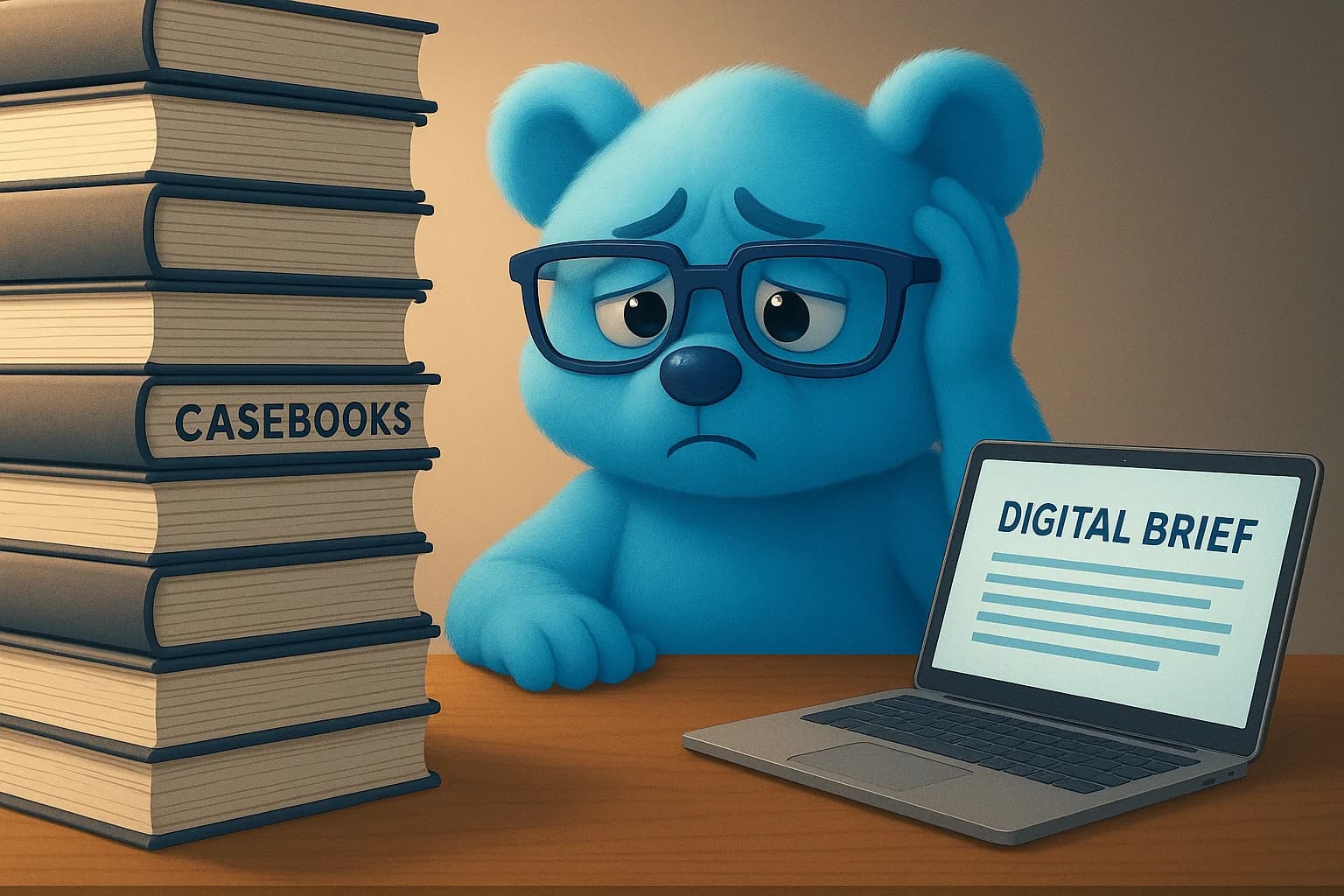
Where to Find Free Case Briefs (and What Each Source Actually Gives You)

It is eleven at night, you have three cases left, and you want a brief for one of them. This is a list of where to actually get one for free, what each source covers, and where each one stops.
A note before the list: a brief you did not make is a supplement, not a substitute. The reading is where the learning happens, and cold calls are built to find the difference. Used as a check on your own brief, or as a way to survive a night when the reading load is impossible, these are genuinely useful.
Free Brief Libraries
Case Cub. Our library covers the canon cases most 1L courses assign, structured with facts, procedural posture, issue, holding, and reasoning. The public library pages are free with no account. A free account with no card opens 5 briefs a day from the full library of 20,000+, each with the full court opinion. Unlimited briefs, the AI quiz studio, flashcards, and Cub Chat are part of the subscription.
Quimbee. The largest commercial library and the one most students know. A small number of briefs and video previews are free, then it is a subscription. Worth knowing which specific cases they leave open.
Casebriefs. Free and ad-supported, organized by casebook, which is genuinely useful because you can find the exact edition your class uses. Coverage is uneven and the writing quality varies a lot by contributor.
Lawnix and similar sites. Free collections of older canon cases. Fine for Palsgraf and Hadley v. Baxendale, thin for anything recent or unusual.
Your school's library guides. Many law libraries maintain a study-aids guide with free access to CALI lessons and other materials your tuition already covers. Ask a research librarian. This is the single most underused resource in law school.
Free Full Opinions, Which Are Often Better
Sometimes you do not want a brief, you want the case. These are all free and all more reliable than any summary.
Google Scholar. Full text of federal and state opinions with citing references. No account needed.
CourtListener. From the nonprofit Free Law Project. Millions of opinions plus oral argument audio, with better state court coverage than Scholar in places.
Cornell Legal Information Institute. The U.S. Code, the CFR, the Federal Rules, and a solid legal dictionary.
Oyez. Supreme Court oral argument audio and case summaries.
Justia. Opinions with practical explainers layered on top.
Westlaw, Lexis, and Bloomberg Law. Free to you as a student and vastly more powerful than anything on this list. Access changes after graduation, so build the habit now.
Or skip the hunt: search 20,000+ briefs, free
Every brief in Case Cub is built from the real opinion, so the citation and the disposition are the actual ones. You get the facts, the posture, the issue, the holding and rationale, the key terms glossary, and the precedent the court relied on, without an account.
How to Tell a Good Free Brief From a Bad One
Free briefs vary wildly. Four things separate the usable ones:
- It states the procedural posture. Who sued whom, what happened below, how it got to this court. Weak briefs skip this and it is the most common cold call opener.
- It names the issue the way the court did. Not the textbook version of the issue, the narrower question the court actually answered.
- The reasoning has steps. "The court held X because the elements were met" is a conclusion, not reasoning. You should be able to reproduce the chain.
- The citation is real. With AI-generated briefs circulating, this is now a live concern. Search the citation in Google Scholar. If nothing comes back, the brief is fiction, and that is the kind of error that turns into academic misconduct if it makes it into a graded assignment.
Faster Than Finding One: Write It
Once you have the method, briefing a case takes fifteen minutes, and the fifteen minutes is the part that shows up on the exam. Our case brief template is a free interactive editor that structures the brief in IRAC, FIRAC, or long form, and the how to brief a case guide walks through the method with a worked case brief example.
Related
- Should You Brief Every Case?
- Case Brief Generator, search 20,000+ briefs written from real opinions
- Free AI Tools for Law Students